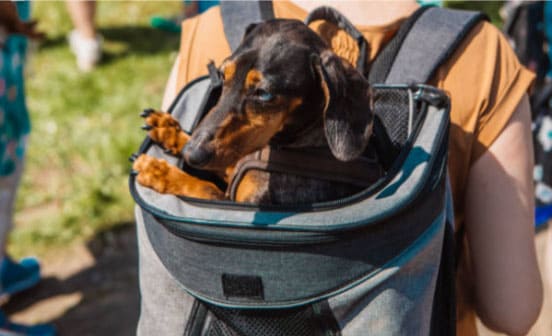
HOW TO CHOOSE
A DACHSHUND CARRIER
THAT FITS YOUR DOG
A carrier labeled "for small dogs" may meet your dachshund's weight requirement yet still leave too little room for their body. Before buying, check the usable space, how the carrier supports your dog, and whether you can carry it steadily.
Your plans matter, too. A short walk to the vet, a trip on public transit, and a longer outing place different demands on the carrier and the person carrying it.
QUICK ANSWER:
WHAT SHOULD YOU
LOOK FOR IN A
DACHSHUND CARRIER?
Choose a dachshund carrier using your dog's measurements and the specific model's fit instructions. Stay within its weight limit, check the space available in the intended carrying position, and look for support that does not sag excessively under your dog.
For an enclosed travel carrier, your dog should be able to stand, turn around, and lie down comfortably. Open-top bags and wearable carriers need their own fit and containment checks. If your dachshund has back pain, diagnosed IVDD, or recent surgery, ask your veterinarian about transport before choosing a carrier.
1. MEASURE YOUR
DACHSHUND
BEFORE CHOOSING
A SIZE
A dachshund’s long body makes length an important part of fit, but width, height, and weight still matter.
There is no single minimum carrier length that fits every dachshund. Adding a fixed number of inches to body length can also produce the wrong result when products use different measurement methods.
Follow the instructions for the specific carrier
Have your dog stand naturally and use a flexible tape measure. Follow the manufacturer’s reference points rather than assuming that "back length" and "body length" mean the same thing.
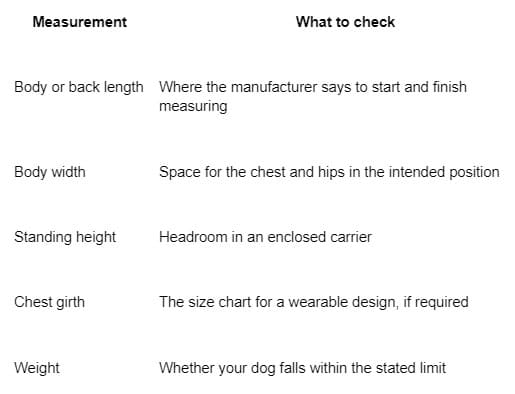
Chest girth is a circumference, so it cannot be compared directly with a carrier’s internal width. Ask whether the listed dimensions describe the exterior or usable interior. Padding, sloped walls, and built-in cushions can reduce the space available.
Miniature and standard dachshunds still need individual fitting
The American Kennel Club’s breed standard places miniature dachshunds at 11 pounds or under at 12 months and older; standard dachshunds usually weigh 16–32 pounds. These classifications do not establish carrier fit. AKC breed standard
A "miniature dachshund carrier" may still be unsuitable for a particular dog's proportions. Likewise, a carrier marketed for the breed may not accommodate the weight or dimensions of every standard dachshund. Coat type should not determine the size you order. Measure a longhaired dachshund using the same care you would use for any dog, following the product's instructions.
2. CHECK RESTING SPACE
AND SUPPORT TOGETHER
For an enclosed carrier, watch whether your dachshund can stand naturally, turn around, and lie down comfortably with the intended bedding in place. These movement checks are also emphasized in the AKC's dog carrier guide.
Look at whether your dog has room to change position. Do not assume that a dog choosing to curl up needs more space, or that fitting through the opening proves the carrier is large enough.
Open-top bags and wearable carriers may position the dog differently. Check the model’s intended posture and fit instructions before applying an enclosed-carrier movement test.
Look for a stable supporting surface
A carrier's padding and structure serve different purposes. A cushion may feel soft while the base beneath it still bends substantially under load.
Check whether:
· The supporting surface extends beneath your dog’s body
· The base sags or folds when your dog is inside
· Edges or openings press into the chest, belly, or limbs
· Your dog slips toward one end when you lift the carrier
· The carrier tilts enough to make handling difficult
Use only the handles, straps, and lifting method specified by the manufacturer. An empty-carrier check cannot establish how the product will perform with your dog inside, and a thumb-pressure test cannot prove spinal safety.
Get individual advice for a dog with back problems
Dachshunds are predisposed to intervertebral disc disease, or IVDD. That makes individual health advice important, but it does not establish that a particular carrier shape prevents disc disease. American College of Veterinary Surgeons
If your dog has pain, a diagnosed spinal condition, or is recovering from surgery, ask your veterinarian about the carrying position, loading method, and any movement restrictions.
Sudden weakness, wobbling, inability to walk, or difficulty urinating warrants urgent veterinary attention. Stop a carrier trial if these signs appear; do not treat them as a fitting problem. ACVS signs and symptoms
3. COMPARE BAGS
AND BACKPACKS
BY THEIR ACTUAL
DESIGN
"Front carrier" describes where you wear a product. It does not necessarily explain your dog’s position inside.
Some designs hold the torso horizontally; others place the dog more upright. A backpack may be fully enclosed, open at the top, or built around a specific supported position. Inspect the layout and instructions rather than deciding from the category name.
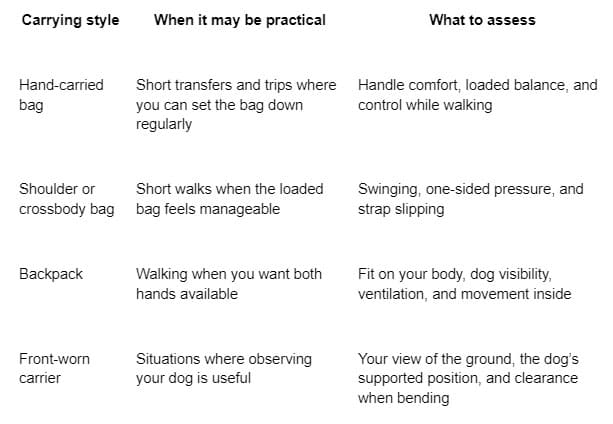
A backpack is not automatically the best option for every dachshund or owner. A well-fitting shoulder bag may work for a brief trip, while a backpack may be easier for another person to manage.
For a dog with a spinal condition, ask your veterinarian before using a design that holds the body in a restricted position.
4. MAKE LOADING,
UNLOADING
AND CONTAINMENT
MANAGEABLE
Think through how you will get your dog into and out of the carrier before buying it.
A low side opening may allow a healthy, willing dog to walk inside. A wide top opening may help with assisted placement. Check that the opening accommodates your dog without forcing the body through or catching the legs.
Set the carrier on a stable surface before loading. If your dog needs lifting, support the chest and hindquarters together and keep the movement controlled. Ask your veterinary team to demonstrate handling if your dog has pain or movement restrictions.
Check what prevents escape
An open-top carrier needs a different containment plan from a fully enclosed travel bag.
Inspect closures, attachment points, and any internal tether. Follow the product's instructions, including the specified harness attachment. A tether should not allow the dog to climb out and become suspended, and it should not create an obvious tangling risk.
Do not leave a carrier partially unzipped in a public place simply to provide headroom. If your dog needs the opening enlarged to fit, reassess the size or design.
Keep your dog supervised, particularly when using an open-top carrier.
5. TRY THE LOADED FIT
BEFORE PLANNING
A LONGER OUTING
A long carrier can be awkward in doorways, on stairs, or when turning in a crowded space. Its dimensions do not tell you exactly how it will balance on your body.
After checking the product's fit and loading instructions, try a brief indoor carry. Notice whether the carrier swings, bumps your legs, or shifts when your dog moves.
You should be able to walk naturally, see where you are stepping, and set the carrier down under control.
Check straps and total weight
Include your dog, the carrier, and anything stored in its pockets when assessing the load.
Wide, adjustable straps and padding may improve comfort. A hip belt may help on a backpack designed to use one, but it cannot correct an unsuitable fit.
Before extending the distance, check:
· Whether straps stay in place
· Whether the carrier pulls you off balance
· Whether you can lift and lower it comfortably
· Whether your dog remains settled
· Whether you have somewhere safe to stop
If the loaded carrier is difficult to manage indoors, choose another setup before taking it onto a trail or busy sidewalk.
6. CHECK VENTILATION AND
EVERYDAY PRACTICALITY
Look for ventilation openings that stay clear while the carrier is in use. Your body, bedding, pockets, or a cover may obstruct part of the airflow.
No mesh-panel count guarantees a safe temperature. Consider the weather, direct sunlight, body contact, and your ability to observe your dog.
For cleaning, check which liners or cushions are removable and follow the care instructions. Do not assume structural panels or the whole carrier can go in a washing machine.
Match the carrier to the trip
For a short vet visit, easy loading and steady carrying may be your main practical concerns. A longer walk also requires attention to total weight, weather, and opportunities for breaks.
For car travel, check that the product is intended for vehicle use and follow its installation instructions. Ordinary carrying straps and internal tethers should not be assumed to provide crash protection.
For flying, confirm your operating airline’s current requirements. Your dog must fit comfortably, and the carrier must meet the rules for the specific journey. The AKC carrier guide recommends checking airline requirements before travel.
7. COMPARING
ATOUPET's
DACHSHUND CARRIERS
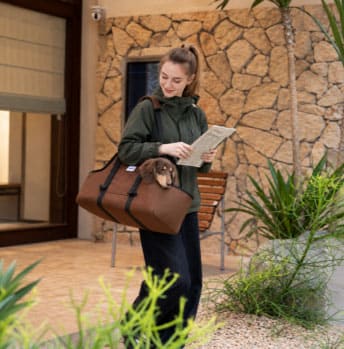
AtouPet's dachshund collection includes the Baguette carrier bag and a convertible carrier backpack. Their listed measurements and carrying options provide a starting point for comparison.
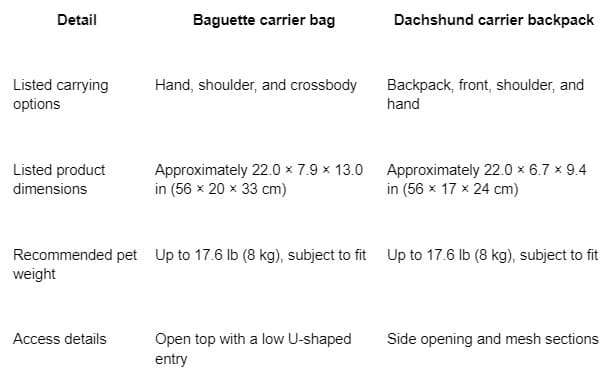
These are listed product measurements, not confirmed usable interior dimensions. Check your dog’s measurements and position in the intended carrying mode before ordering.
AtouPet dachshund carrier collection
If a measurement is unclear, ask for usable interior dimensions and the fit instructions for the mode you plan to use.
DACHSHUND CARRIER
BUYING CHECKLIST
Before ordering, confirm that:
· Your dog falls within the stated weight limit.
· You followed the model’s measurement instructions.
· You checked usable space and the intended carrying position.
· The supporting structure accommodates your dog without obvious sagging or pressure.
· The opening allows manageable loading and unloading.
· Closures and any tether can be used as instructed.
· Ventilation stays unobstructed during use.
· You can manage the combined weight steadily.
· You checked the return policy in case the fit is unsuitable.
If your dachshund has a spinal condition or recent surgery, get veterinary transport advice before a trial.
For broader pet travel gear and ideas beyond dachshund carriers, you can also explore AtouPet
FREQUENTLY ASKED QUESTIONS
① What size carrier does a dachshund need?
There is no universal dachshund carrier size. Follow the specific product's measurement instructions and check its weight limit. For an enclosed carrier, assess whether your dog can stand, turn, and lie down comfortably.
② Is a backpack suitable for a dachshund?
It may be, depending on the design, fit, supported position, and your dog’s health. Check how the product holds your dog and how steadily you can carry it. The word “backpack” alone does not establish suitability.
③ Does a longhaired dachshund need a larger carrier?
Coat type alone does not determine carrier size. Measure your dog and check the usable space with the intended liner or cushion installed.
④ Can a carrier prevent IVDD?
A breed-specific label or firm base does not establish IVDD prevention. Carrier selection should address fit and handling; a dog with a spinal condition needs individual veterinary advice.
⑤ Is it a problem if my dachshund curls up inside?
Check whether your dog has room to choose another comfortable position. If the carrier forces your dog into one posture or they appear uncomfortable, reassess the fit. Do not force a dog to stretch out for a fitting check.
⑥ Can I use a dachshund carrier during recovery from back surgery?
Ask the treating veterinary team before doing so. Bring the product details so they can assess the position, entry method, and suitability for your dog’s recovery instructions.
⑦ What if my dachshund will not settle in the carrier?
Check the fit and introduce the carrier gradually at home. Begin with voluntary investigation and brief sessions before carrying. Stop if your dog struggles or appears painful, and seek veterinary advice if the discomfort persists.
Like DOGICA ?
Share this page !
      
Support us by Paypal here:

BY USING THIS SITE
YOU ARE AGREE ON:
All materials & images on DOGICA® pages
respectfully belong to its legal rights owners.
All images on DOGICA® pages
used only as illustrations.
All AI images created by DOGICA.
Find the author of any image with TINEYE
Most of used images courtesy of:
Shutterstock, Getty Images, Pixabay, Freepik
Pngtree, Dreamstime, IStockphoto, Unsplash,
Adobe Stock
Dogica® collects only technical cookies.
No any personal or private information
being collected, saved or shared here.
3rd Party cookies could be collected
by various installed widgets.
The information contained in or provided through DOGICA® site is intended for general consumer understanding and education only and is not intended to be and is not a substitute for professional advice.
Use of this site and any information contained on or provided through this site is provided on an "as is" basis without any representations, warranties or pay.
CONTACT DOGICA®
If you are a legal rights owner and would like
to add, update or remove your material.
Translate DOGICA®
with Google Translate DOGICA®
with Yandex

 |





WORLD OF DOG & PUPPY 🐶